

INTRODUCTION
The parameters of most devices at normal temperatures have approached their technical limit. This means that the possibilities determined by the properties of materials have been largely exhausted. Cooling is one of the obvious ways to significantly change the properties of some materials. The use of superconducting materials is effective, with a minimal risk of system failure, only in a narrow range of cryogenic temperatures, which entails significant costs and is sometimes extremely difficult. The use of superconducting materials has other enormous difficulties and limitations, including limitations in some tasks and conditions for other physical characteristics and properties.
Materials are often of interest due to a combination of several physical characteristics and properties. Electrical conductivity, thermal conductivity, thermal diffusivity, reflection coefficient, yield strength, etc. are not the only things that can be of interest. Such parameters as toxicity, complexity of processing, brittleness under external influence, etc. also have a serious impact on the use of some materials. Therefore, the possibilities of manufacturing systems and device elements from non-superconducting metals are being considered, including those that do not necessarily operate at helium temperatures.
Materials are often of interest due to a combination of several physical characteristics and properties. Electrical conductivity, thermal conductivity, thermal diffusivity, reflection coefficient, yield strength, etc. are not the only things that can be of interest. Such parameters as toxicity, complexity of processing, brittleness under external influence, etc. also have a serious impact on the use of some materials. Therefore, the possibilities of manufacturing systems and device elements from non-superconducting metals are being considered, including those that do not necessarily operate at helium temperatures.
COPPER
Copper is of particular interest in many respects. Copper has high electrical and thermal conductivity characteristics and is used in various fields and devices. It is known that electrical conductivity (and not only) significantly depends on the presence of impurities in copper and its crystalline structure. Hundredths and thousandths (and less) of a percent of impurity can sharply reduce its thermal and electrical conductivity. The influence of impurities is most noticeable in cryogenics.
It is more common to use the inverse value of electrical conductivity - electrical resistance, in particular the RRR characteristic, to display the quality of copper.
RRR is the relative residual resistance, measured by the ratio of the electrical resistance of copper at 273–293 to the resistance in liquid helium at 4–4.2 K (the differences are insignificant). Copper of different qualities has virtually no differences in resistance and thermal conductivity at room temperature, but differs significantly at low temperatures.
RRR is a kind of characteristic of copper quality, i.e. its purity and perfection.
It is more common to use the inverse value of electrical conductivity - electrical resistance, in particular the RRR characteristic, to display the quality of copper.
RRR is the relative residual resistance, measured by the ratio of the electrical resistance of copper at 273–293 to the resistance in liquid helium at 4–4.2 K (the differences are insignificant). Copper of different qualities has virtually no differences in resistance and thermal conductivity at room temperature, but differs significantly at low temperatures.
RRR is a kind of characteristic of copper quality, i.e. its purity and perfection.
For general information, graphs of the behavior of electrical resistance and thermal conductivity depending on the quality of copper and temperature are presented below.

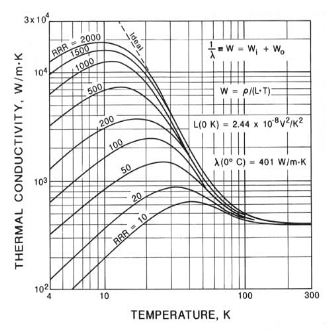
The graph shows the behavior of the electrical resistance of copper of quality RRR 10-2000 and "ideal copper". According to calculations, "ideal copper" reaches values of RRR 10,000. Thus, the electrical resistance of copper can differ by up to three orders of magnitude.
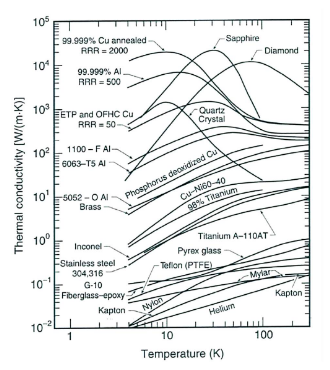
The graph shows the behavior of the thermal conductivity of copper of RRR 10-2000 quality and "ideal copper". Yes, you see everything correctly. The thermal conductivity of copper at cryogenic temperatures changes by two orders of magnitude already for copper of RRR 20-2000 quality.
The difference of two orders of magnitude in thermal conductivity between copper with an RRR of 2000 and with an RRR of 20 turns the 15-minute time to reach thermal equilibrium for the former into more than a day of waiting for the latter.
The difference of two orders of magnitude in thermal conductivity between copper with an RRR of 2000 and with an RRR of 20 turns the 15-minute time to reach thermal equilibrium for the former into more than a day of waiting for the latter.
Copper, even at RRR ≈ 2000, has a thermal conductivity comparable to the highest values of diamond and sapphire, but in slightly different temperature ranges. Diamond and sapphire are significantly inferior to copper at temperatures below 20 K, especially at T < 10 K and helium temperatures. The properties of sapphire and diamond also depend on their quality.
Graph courtesy of "Cryogenic Properties of Materials - Thermal Conductivity," CERN.
Graph courtesy of "Cryogenic Properties of Materials - Thermal Conductivity," CERN.
WHAT ELECTRICAL AND THERMAL CONDUCTIVITY VALUES CAN BE ACHIEVED?
For obvious reasons, the results obtained apply to oxygen-free copper: oxygen in very pure copper, even at levels of 25 ppm, can dramatically reduce the RRR from 2000 to 50. Calculated RRR values for ideal copper are often quoted as 10,000.
The following results were obtained in some research studies:
copper sample 99.999% was obtained as a single crystal with an RRR of 4.2K ~2000
copper sample with characteristics of RRR 4.2K ~2900 and λ 4.2K ~16,500 W /m*K
copper sample 99.9999% with an RRR of 4.2K ~5760 and λ 8K ~30,200 W /m*K
copper sample with an RRR of 8000.
Also:
.Mitsubishi has an offer for copper with an RRR>3000 for aerospace R&D
.At CERN, copper with an RRR of ~5000 is used in cryogenic systems and microwave applications.
However, some scientific papers indicate a theoretical and practical limit for RRR characteristics well above 10,000, and RRR ~30,000 is often mentioned as a "common thing".
Some studies claim to have achieved RRRs of over 10,000 for extremely pure copper. Small residual impurities are converted into oxides using a special annealing procedure in an oxygen environment, thereby reducing resistance compared to if the residual impurities were in solution.
In 2012, JX Nippon Mining & Metals filed a patent application for a method for producing ultra-pure copper with exceptional properties. Important and interesting details are provided:
Some studies claim to have achieved RRRs of over 10,000 for extremely pure copper. Small residual impurities are converted into oxides using a special annealing procedure in an oxygen environment, thereby reducing resistance compared to if the residual impurities were in solution.
In 2012, JX Nippon Mining & Metals filed a patent application for a method for producing ultra-pure copper with exceptional properties. Important and interesting details are provided:
- "Standard 6N copper" with a roughness factor (RRR) of ~6,000–10,000 was produced and studied.
- The possibility of producing ultra-pure copper with a roughness factor (RRR) of ~40,000–100,000 was studied and claimed. A copper sample with an RRR of over 38,000 was obtained.
- Using a magnetron sputtering target to form a thin film of high-purity copper, it was found that the deposition characteristics and stability of deposition conditions significantly depend on the purity of the target.
The results are extremely interesting. We've taken note. We have a rough idea of how it was done. It's still unclear to what extent the extremely pure copper samples obtained were "commercial in shape and size."



We developed our project at the same time as JX Nippon Mining & Metals. We received the first official quality confirmations in 2012. We didn't conduct research into the feasibility of producing ultra-pure copper with the highest characteristics, but immediately focused on establishing the production of small pilot commercial batches of the highest quality. This is somewhat different. In production, we implemented measures to achieve the highest possible copper purity and a structure close to monocrystalline. We didn't have time to implement some of the planned technological measures, but we compensated for this in other ways.
It's possible that we also partially automatically implemented "oxygen treatment" of our products to form oxides, as we obtained extremely high % IACS values for samples with some iron content. Ingots are similar to single crystals—their large-block crystalline structure also improves their properties. However, the % IACS results for certain Fe contents support the possibility of this option for improving physical properties; otherwise, such % IACS characteristics would likely not be achieved even for single crystals
It's possible that we also partially automatically implemented "oxygen treatment" of our products to form oxides, as we obtained extremely high % IACS values for samples with some iron content. Ingots are similar to single crystals—their large-block crystalline structure also improves their properties. However, the % IACS results for certain Fe contents support the possibility of this option for improving physical properties; otherwise, such % IACS characteristics would likely not be achieved even for single crystals
Our technology is slightly different. Did we have a quality comparable in chemical purity and characteristics? Quality "standard 6N copper with an RRR of 6,000 - 10,000" and higher should be available, but we don't know how much higher. We probably haven't reached a quality with an RRR of 40,000. Perhaps the upper limit for our technology is RRR 20,000. However, we weren't aiming for a single, exceptionally high result, but rather for pilot production of small commercial batches of a high-quality experimental product. We planned, if necessary, to implement a "second purification cycle" in our technology, but the first cycle also performed very well.
Our characteristics forecasts still require refinement. We are still "categorically" not receiving results for chemical purity and characteristics of samples with above-average level, while "average samples of 6N5 level" and below, purity measurements are "distorted." We don't always track what results others have achieved and where, but sometimes we write: "Considering our technology, which, while maintaining process hygiene, extracted everything possible, making further improvement highly problematic," we believe we that back in 2012 we achieved 30-70% of the characteristics level, regardless of what the commercial technological limit achieve success in the world.". But this requires verification.
P. S.
We assume that the achieved RRR value of 38,000 refers to extremely pure copper, likely in the form of a single crystal of sufficient size. This is most likely an experimental scientific sample, the commercialization of which is difficult. The aforementioned RRR limit of 100,000 may be a theoretical limit for copper, but it is unattainable in practice. We are not confirming this - it is just an assumption.
Our characteristics forecasts still require refinement. We are still "categorically" not receiving results for chemical purity and characteristics of samples with above-average level, while "average samples of 6N5 level" and below, purity measurements are "distorted." We don't always track what results others have achieved and where, but sometimes we write: "Considering our technology, which, while maintaining process hygiene, extracted everything possible, making further improvement highly problematic," we believe we that back in 2012 we achieved 30-70% of the characteristics level, regardless of what the commercial technological limit achieve success in the world.". But this requires verification.
P. S.
We assume that the achieved RRR value of 38,000 refers to extremely pure copper, likely in the form of a single crystal of sufficient size. This is most likely an experimental scientific sample, the commercialization of which is difficult. The aforementioned RRR limit of 100,000 may be a theoretical limit for copper, but it is unattainable in practice. We are not confirming this - it is just an assumption.

The graphs show calculated values for the behavior of copper characteristics. For copper, existing mathematical models are fairly closely supported by experimental studies. However, caution is still required—these are calculated data, and at low temperatures, depending on residual impurities and defects, there may be some discrepancies with experimental data.
Impurity scattering dominates at low temperatures, while electron-phonon scattering becomes important at higher temperatures. These properties are essential for applications requiring the highest thermal and electrical conductivity in cryogenic conditions, such as quantum computing and advanced electronics, where minimal energy loss is critical. Research confirms that extreme purity significantly enhances copper's inherent excellent conductivity.
At very low temperatures, some anomalies and deviations from the Wiedemann-Franz law, which relates thermal and electrical conductivity, are observed, indicating complex scattering mechanisms. For example, experimental data for "99.9999% Cu with RRR characteristics of 4.2K ~5760 and a peak λ value of 8K ~30200 W/m*K" diverge from the Wiedemann-Franz law. In extreme situations, this may be due to the complexity of small measurements under specific limiting conditions, as well as to possible imperfections in the mathematical model for these conditions and their quality. The question also arises of the availability of suitable samples for such measurements—both for confirmation and for correction. This is not surprising: "Newton's laws also reflect events well in some places, less well in others, and in others not at all... and over time, adjustments are made or new local models are created for specific conditions..."
RRR (residual resistance coefficient) characteristics indicate the purity of a metal based on its behavior at cryogenic temperatures - a measure of chemical purity and the perfection of its crystalline structure. Achieving an RRR of 1000 - 2000 is challenging, but it is a well-established and achievable figure for commercial applications. Beyond this point, the difficulty and cost of achieving higher values increases exponentially. RRR values of 5000 - 10000 were considered extremely high over the past decade and likely remain so today, representing a kind of "gold standard" for high-tech applications.
Taking into account the results obtained by JX Nippon Mining & Metals, some "oxygen technologies," and considerations based on our technology, we will proceed from the following assumptions for the present and "some future time":
Impurity scattering dominates at low temperatures, while electron-phonon scattering becomes important at higher temperatures. These properties are essential for applications requiring the highest thermal and electrical conductivity in cryogenic conditions, such as quantum computing and advanced electronics, where minimal energy loss is critical. Research confirms that extreme purity significantly enhances copper's inherent excellent conductivity.
At very low temperatures, some anomalies and deviations from the Wiedemann-Franz law, which relates thermal and electrical conductivity, are observed, indicating complex scattering mechanisms. For example, experimental data for "99.9999% Cu with RRR characteristics of 4.2K ~5760 and a peak λ value of 8K ~30200 W/m*K" diverge from the Wiedemann-Franz law. In extreme situations, this may be due to the complexity of small measurements under specific limiting conditions, as well as to possible imperfections in the mathematical model for these conditions and their quality. The question also arises of the availability of suitable samples for such measurements—both for confirmation and for correction. This is not surprising: "Newton's laws also reflect events well in some places, less well in others, and in others not at all... and over time, adjustments are made or new local models are created for specific conditions..."
RRR (residual resistance coefficient) characteristics indicate the purity of a metal based on its behavior at cryogenic temperatures - a measure of chemical purity and the perfection of its crystalline structure. Achieving an RRR of 1000 - 2000 is challenging, but it is a well-established and achievable figure for commercial applications. Beyond this point, the difficulty and cost of achieving higher values increases exponentially. RRR values of 5000 - 10000 were considered extremely high over the past decade and likely remain so today, representing a kind of "gold standard" for high-tech applications.
Taking into account the results obtained by JX Nippon Mining & Metals, some "oxygen technologies," and considerations based on our technology, we will proceed from the following assumptions for the present and "some future time":
- The commercial technological limit of RRR is 20,000.
- Until we "better understand some violations of the Wiedemann-Franz law," we will assume for now that the thermal conductivity at 4.2 K for an RRR of 20,000 is "50,000+ W/m*K."
CLASSIC COPPER 99.50 - 99.99%
Classic copper and its grades are described by well-known generally accepted standards and have a purity in the range of 99.50-99.99%. The standards describe a specific list of chemical elements, according to which chemical purity and specific restrictions for each chemical element or group of them are determined for each grade of copper. Accordingly, different grades differ slightly in characteristics and are used for their own purposes. The most well-known standards are GOST 859 (Russia) and ASTM B170 (USA). Similar standards exist in other countries.
% IACS and RRR for Cu 99.5 - 99.99%
Characteristics of 99.5% - 99.99% vary greatly, although in some cases they may appear similar in electrical conductivity. This depends on the specific amounts of specific impurities, although overall purity as a number may not change.
It depends on the specific copper grade, batch, and sample, but typical approximate electrical conductivity ~ % IACS:
99.5% ~ 96 - 99
99.9% ~ 99 - 100
99.95% ~ 100 - 101
99.99% ~ 101 - 102
Typical approximate RRR 10 - 200.
% IACS and RRR for Cu 99.5 - 99.99%
Characteristics of 99.5% - 99.99% vary greatly, although in some cases they may appear similar in electrical conductivity. This depends on the specific amounts of specific impurities, although overall purity as a number may not change.
It depends on the specific copper grade, batch, and sample, but typical approximate electrical conductivity ~ % IACS:
99.5% ~ 96 - 99
99.9% ~ 99 - 100
99.95% ~ 100 - 101
99.99% ~ 101 - 102
Typical approximate RRR 10 - 200.
CLASSIC OXYGEN-FREE COPPER 99.95 - 99.99%
Oxygen-free copper has the highest characteristics among classical copper, which is explained by higher requirements for overall purity and specific impurity content.
|
OFC Worldwide Specification
|
|||||||||||||||
|
Natoin
|
Russia
|
USA
|
Japan
|
UK
|
Germany
|
||||||||||
|
Srandard
|
GOST 859
|
ASTM B170
|
JISH2123
|
BS6017
|
DINI787
|
||||||||||
|
Classification
|
|||||||||||||||
|
Grade 1
|
Grade 2
|
Grade 1
|
Grade 2
|
Cu-OFE
|
Cu-OF
|
OF-Cu
|
|||||||||
|
М00Б
|
M0Б
|
C10100
|
C10200
|
C1011
|
C1020
|
C103
|
C110
|
2.0040
|
|||||||
|
Cu, % min
|
99.99
|
99.97
|
99.99
|
99.95
|
99.99
|
99.96
|
99.99
|
99.95
|
99.95
|
||||||
|
Including:
|
|||||||||||||||
|
P, ppm
|
3 max
|
20 max
|
3 max
|
NA
|
3 max
|
NA
|
3 max
|
NA
|
NA
|
||||||
|
O2, ppm
|
10 max
|
10 max
|
5 max
|
10 max
|
10 max
|
10 max
|
10 max
|
NA
|
NA
|
||||||
The Effect of Oxygen
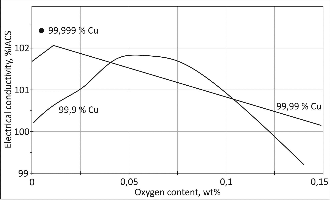
For copper grades 99.9–99.99% pure, oxygen concentrations range from 5 to 500 ppm. With many impurities, oxygen can form oxides.
Since the impurities are no longer in solution, their impact on conductivity is reduced, but too little or too much oxygen in a particular copper grade or sample will impair electrical conductivity.
Since the impurities are no longer in solution, their impact on conductivity is reduced, but too little or too much oxygen in a particular copper grade or sample will impair electrical conductivity.
CHEMICAL PURITY AND SOME CHARACTERISTICS
Classic oxygen-free copper is “conditionally” divided into Pure and High-purity oxygen-free copper with chemical purity according to generally standards of min 99.95% and min 99.99% respectively, and with characteristics of RRR 100-200 and λ 4.2K 400-1500 W /m*K.
There is a special grade of copper CG-OFC manufactured by Hitachi Cable Ltd (Japan) for use in cryogenics with characteristics of RRR 4.2K ~500 and λ 4.2K ~3000 W /m*K.
Below are some characteristics that are currently being compared to "some modern technologically achievable commercial maximum RRR ~10000" and they are very low...
There is a special grade of copper CG-OFC manufactured by Hitachi Cable Ltd (Japan) for use in cryogenics with characteristics of RRR 4.2K ~500 and λ 4.2K ~3000 W /m*K.
Below are some characteristics that are currently being compared to "some modern technologically achievable commercial maximum RRR ~10000" and they are very low...
|
CLASSIC OXYGEN-FREE COPPER
|
||||||||||||||
|
|
||||||||||||||
|
Complete purity
|
Metal base
|
Charactiristics
|
||||||||||||
|
Cu OF
|
Brands
|
Cu
|
Cu+Ag
|
Cu
|
Cu+Ag
|
% IACS
|
RRR 4.2K
|
λ 4.2K
|
λ 4.2K / λ 293K
|
% «Max»
|
||||
|
Min, %
|
~
|
~
|
~W /m*K
|
~
|
~
|
|||||||||
|
Classic
|
||||||||||||||
|
-- Pure
|
М0б, С10200, C1020, Cu-OF
|
99.95
|
99.97
|
99.95
|
99.97
|
100
|
100
|
400
|
1
|
1
|
||||
|
-- High-pure
|
М00б, С10100, C1011, Cu-OFE
|
99.99
|
99.992
|
99.991
|
99.993
|
102
|
250
|
1500
|
4
|
2 -- 3
|
||||
|
For cryogenics
|
CG-OFC Hitachi Cable Ltd
|
99.99+
|
99.99+
|
99.99+
|
99.99+
|
102+
|
500
|
3000
|
7.5
|
3 --
|
||||
|
% «Max» - approximate % of possible technological values RRR=20 000 and "corresponding" Thermal Conductivity "50 000+ W /m*K ?
|
||||||||||||||
|
Complete purity according to GOST 859 and ASTM B170: "100% - {16 elements: metals P, Mn, Fe, Ni, Zn, As, Ag, Cd, Sn, Sb, Pb, Bi + non-metals O, S, Se, Te}". |
||||||||||||||
|
% IACS - electrical conductivity relative to standard
RRR 4.2K - relative residual resistance ( RRR 4.2K=R 293K /R 4.2K - how many times does the resistance decrease at 4.2K ) λ 4.2K - Thermal conductivity at 4.2K ; λ 4.2K / λ 293K - the ratio of Thermal conductivity at 4.2K to Thermal conductivity at 293K ( 20 C ) |
||||||||||||||
ABOUT COPPER 99.995 - 99.999% AND HIGHER
In classical production, individual results of copper grade purity may be higher than those stated in the GOST 859 and ASTM B170 standards, but only what is specified there is guaranteed, and for the best copper grades this is only "not less than 99.99%". Ensuring guaranteed compliance with the purity of 99.99% according to these standards is not so simple: in addition to the general purity for the declared impurities, it is necessary to comply with the restrictions for each of them.
There are other, non-mass technologies, but they also have a number of their own limitations and difficulties. For impurities of the GOST 859 and ASTM B 70 standards and these technologies, it is extremely difficult to achieve a guaranteed result of 99.995-99.999% and a guaranteed result above 99.999% in non-laboratory quantities and forms.
There are other, non-mass technologies, but they also have a number of their own limitations and difficulties. For impurities of the GOST 859 and ASTM B 70 standards and these technologies, it is extremely difficult to achieve a guaranteed result of 99.995-99.999% and a guaranteed result above 99.999% in non-laboratory quantities and forms.
Therefore, copper of 99.995-99.999% and higher is often offered according to Technical Conditions (TC) that describe their own list of chemical elements for determining purity. Such a list of elements often differs greatly from the list proposed in the GOST 859 and ASTM B170 standards, but a certain purity is calculated according to it. The rules for "calculating purity" often change - it is determined by some elements even from this list of elements, and the limits of determination when calculating purity are sometimes taken as 0.
Care must be taken: to a lesser extent, but this approach is also found in serious catalogues for highly pure chemicals. The copper offered in this way often does not correspond to the classic copper of 99.99% and even often 99.9%, and may have corresponding characteristics and properties.
In some tasks, it is permissible not to take into account some impurities, since copper can be contaminated to a greater extent by them in the subsequent technological process and/or some characteristics are not decisive for this task. In some special tasks, this can be critical. For example, in cryogenics products, any impurity has an effect, to a greater or lesser extent... These points must be distinguished and linked to the task.
Care must be taken: to a lesser extent, but this approach is also found in serious catalogues for highly pure chemicals. The copper offered in this way often does not correspond to the classic copper of 99.99% and even often 99.9%, and may have corresponding characteristics and properties.
In some tasks, it is permissible not to take into account some impurities, since copper can be contaminated to a greater extent by them in the subsequent technological process and/or some characteristics are not decisive for this task. In some special tasks, this can be critical. For example, in cryogenics products, any impurity has an effect, to a greater or lesser extent... These points must be distinguished and linked to the task.
A doubling of the value is often considered a significant achievement. Of course, not everything is calculated exactly as described in the example, and the cooling problem is complex, but solvable. A more precise assessment for a specific problem and conditions is a matter for specialists.
We simply emphasize the correct definition and understanding of Cu 5N - 7N and the possibility of obtaining a multiplier effect from several changing characteristics.
For additional information, see the " In addition " section in the following subsections:
We simply emphasize the correct definition and understanding of Cu 5N - 7N and the possibility of obtaining a multiplier effect from several changing characteristics.
For additional information, see the " In addition " section in the following subsections:
- About copper purity
- Impurities and structure
- Standards and Customs Unions
- Info

Cu 5N - 7N ассоrding to TC={ Li, Be, Ti, V, Co, Mo, Cd, Pt, Au, Bi } and SOME OTHERS
Copper with a purity of 99.9% according to GOST 859, ASTM B170, and the corresponding standards of some other countries, as well as "some bronze, brass, and some copper scrap," are often "easily recycled into 5N-7N copper" according to these specifications. What characteristics and properties can be expected from such 5N-7N copper?
- Virtually nothing can be determined until the chemical composition is clarified according to generally accepted standards and, just in case, for several other impurities.
- If you need RRR, you can say: "10 - 10,000, somewhere around there..." RRR could be 10, or it could be 10,000, meaning electrical and thermal conductivity in cryogenics can differ by hundred of times! For example, waiting for thermal equilibrium instead of 15 minutes could take over a day, or even longer.
The characteristics and properties of this copper can have any value, but a visual assessment of 5N-7N copper offered "on the market" typically shows a content of 99.9% or lower, according to GOST 859.
Why are there technical specifications that allow almost any copper to be called 5N-7N, and no characteristics or properties of such copper can be described?
&
The use of copper in some applications can have a multiplicative effect on the resulting performance. Suppose the system is in equilibrium with the original "6N copper meeting these specifications" at the corresponding low temperatures. What can be achieved by using true, high-quality 6N copper?
- Thermal conductivity can be more than 100 times.
- Thermal diffusivity can be 200 times higher.
Thermal diffusivity is the ratio of thermal conductivity to (specific heat capacity × density) and characterizes the rate of heat transfer and the achievement of thermal equilibrium. According to some data, purer copper has a lower specific heat capacity. Some argue that it remains generally unchanged, but at < 0.1 K, the heat capacity of less purified copper can differ significantly, which may be important for quantum and other applications. Clarification is required. Suppose the specific heat capacity of real copper 6 is half that of "purer" copper. Then thermal diffusivity will be 200 times higher, and 200 times more heat can be removed per unit time.
- The reflected radiation power is 400 times higher.
Reflection losses are losses due to surface heating during reflection, are lower in purer copper. Let's assume the losses be half that, but it depends on the wavelength. With sufficient cooling capacity, it is possible to reflect a radiation flux of twice the power. Given a thermal diffusivity 200 times greater, it is possible to reflect a radiation flux 400 times greater than the original.
A 100-fold difference in one characteristic can lead to a 400-fold difference in another required characteristic!
A 100-fold difference in one characteristic can lead to a 400-fold difference in another required characteristic!
SUPER-PURE OXYGEN-FREE COPPER ( SP OFC, manufactured by Sibneotech LLC)
We have conducted R&D and created experimental production. We have obtained stable guaranteed results and produced an experimental product of the highest quality: Super-pure and Ultra-pure copper in ingots similar to a single crystal. Ultra-pure copper was obtained in the process of research of technological parameters and is not planned for release.
Chemical purity is determined by impurities of generally standards GOST 859 (Russia) and ASTM B170 (USA), and according to generally simple mathematical rules for calculating purity, which are defined in these standards.
Chemical purity is determined by impurities of generally standards GOST 859 (Russia) and ASTM B170 (USA), and according to generally simple mathematical rules for calculating purity, which are defined in these standards.
CHEMICAL PURITY
Chemical purity is stated "not for the best, but for a slightly above-average level of measurement, so that it can be measured." For Extra quality copper, the highest quality measurement is required, although the main differences are only in Fe and Ag.
Unfortunately, we are not provided with third-party chemical purity test results for quality "above average - 6N5+ level and above," only "everything is fine, as you say." Analysis results for "average samples - 6N5 level" and below are "distorted" and raise serious questions about adherence to chemical analysis procedures: sometimes "obvious falsifications or a sharp reduction in possible measurement limits are visible," and the results clearly contradict our own previous analyses and measured characteristics.
More information is available in the sections:
Unfortunately, we are not provided with third-party chemical purity test results for quality "above average - 6N5+ level and above," only "everything is fine, as you say." Analysis results for "average samples - 6N5 level" and below are "distorted" and raise serious questions about adherence to chemical analysis procedures: sometimes "obvious falsifications or a sharp reduction in possible measurement limits are visible," and the results clearly contradict our own previous analyses and measured characteristics.
More information is available in the sections:
- "PRODUCTS / Specifications"
- "PRODUCTS / Certification"
- "PRODUCTS / Characteristics".
A pilot batch was produced in a single process cycle to test production capabilities, and a second purification cycle was considered if necessary. This is challenging, but so far the first one has worked very well.
% IACS ~ 104 - 105
According to some data, the limiting values of % IACS for copper are:
- 103.0 - 103.5% "polycrystalline copper, absolutely free of impurities": in some studies, these are the limiting values
- 103.5 - 104.5% "defect-free annealed copper samples": CERN/DESY technical reports (SRF and RuPAC conference proceedings)
- 104.4 - 104.6% "with complete elimination of lattice defects and impurities": Fundamental Research in Solid State Physics (Journal of Applied Physics)
- 105 - 106% "perfect copper, absolutely free of defects": in some experimental studies, these are the limiting theoretical calculated values
- Above, "copper with some manipulation": mentioned during thermomechanical processing of a single crystal under high pressure or with the addition of graphene layers.
For general information, not for "engineering calculations".
We achieved extremely high % IACS measurements for our entire product: they approach, are on par with, or even slightly exceed various experimental and theoretical values for "ideal copper" cited in various sources. Assuming that we made a significant error in our % IACS calculations—which is unlikely—by exceeding someone's theoretically calculated limit, an interesting fact is that the Institute of Applied Physics of the Russian Academy of Sciences also exceeded its calculated values for "ideal copper" for the "Reflection Loss" characteristic when testing our "average sample" at room temperature, although the results fell just short of the calculated values in cryogenics. Calculated values aren't always the "ultimate authority," but they should be taken seriously; they provide a good criterion for verifying results and a guard against dubious achievements, especially if the calculated values were produced by reputable individuals and institutions.
RRR and THERMAL CONDUCTIVITY
We can't yet determine our exact specifications. We are still being "categorically" denied results on the chemical purity and characteristics of samples above average, while "average samples of 6N5 level" and below are being "distorted."
But still, “some general considerations and mentions”:
But still, “some general considerations and mentions”:
- As the temperature of liquid helium approaches, the thermal vibrations of copper atoms virtually cease. Residual resistance becomes entirely determined by structural defects and impurities. As the grain size increases by 50-100 times, the density of "walls" in the electron path decreases proportionally. As a result, residual resistance drops severalfold, and RRR rises sharply and is limited only by residual impurities. In this situation, much depends on the specific chemical composition and the state of the specific impurities: in solid solution or as compounds, their resistance may decrease, and RRR may also increase.
- We obtained extremely high % IACS measurements for our entire product: they approach, are on par with, or even slightly exceed some experimental and theoretical values for "ideal copper" cited in various sources. The Institute of Applied Physics of the Russian Academy of Sciences also exceeded its calculated values for "ideal copper" in the "Reflection Loss" characteristic when testing our "average sample" at room temperature, although the results fell just short of the calculated values in cryogenics.
- Copper Cu OFE with a purity of 99.99%+, an RRR of 300-400, and approximately 101.7% IACS reaches 102.8% IACS and an RRR of 1000-2000 when transformed into a large-block crystalline form. This means that the RRR increases by a factor of 3-5. These values also depend on the specific chemical composition and can be slightly lower or slightly higher. Some studies have obtained a copper sample of 99.999% purity with an estimated 102.5% IACS as a single crystal with an RRR of 4.2K ~2000. The exact chemical compositions are unknown and likely vary, which is important. However, we are confident that the chemical purity is significantly lower than our "worst samples," and the difference between the single crystal and the large-block crystalline structure of our ingots can be neglected.
- If copper shows 104% IACS or higher, it's a sure sign that a single-crystal or large-block structure has formed. Figures around 104% IACS or higher are a sign of exceptional quality material, which is used in advanced technologies. For example, if a single crystal shows such IACS % values, it's almost a guarantee that the RRR will reach 5,000-10,000.
- Some of our product is comparable in chemical purity to very pure small-sized polycrystalline copper with an RRR > 3000. Certain considerations suggest that switching to the size of our ingots with a large-block crystal structure should increase the RRR severalfold. If "on average 3-5 times," then to an RRR of 9,000-15,000? There is a slightly better quality in chemical composition, but we don't know where or how to measure it. What will happen to samples with a poorer chemical composition? The chemical composition isn't that much worse; only Fe changes primarily. The % IACS is also extremely high, and some compensation for the negative impact of some impurities must have occurred in the "oxygen variant"; otherwise, even single crystals wouldn't have achieved such % IACS values.
Achieving an RRR of 1000 - 2000 is challenging, but it is a well-established and achievable figure for commercial applications. Beyond this point, the difficulty and cost of achieving higher values increases exponentially. RRR values of 5000 - 10000 were considered extremely high over the past decade and likely remain so today, representing a kind of "gold standard" for high-tech applications. Taking into account the results obtained by JX Nippon Mining & Metals, some "oxygen technologies," and considerations based on our technology, we will proceed from the following assumptions for the present and "some future time":
- The commercial technological limit of RRR is 20,000.
- Until we "better understand some violations of the Wiedemann-Franz law," we will assume for now that the thermal conductivity at 4.2 K for an RRR of 20,000 is "50,000+ W/m*K."
Our predictions regarding physical characteristics require further clarification; there are “nuances” that require more careful consideration. We don't always track what results others have achieved and where, but sometimes we write: "Considering our technology, which, while maintaining process hygiene, extracted everything possible, making further improvement highly problematic," we believe we that back in 2012 we achieved 30-70% of the characteristics level, regardless of what the commercial technological limit achieve success in the world.". But this requires verification. It is long, complicated, difficult, but nevertheless, sometimes some results of chemical analyses and characteristics obtained lead to confirmation of our forecasts.
CHEMICAL PURITY AND SOME CHARACTERISTICS
|
SUPER-PURE OXYGEN-FREE COPPER compared to classic oxygen-free copper and CG-OFC
|
||||||||||||||
|
|
||||||||||||||
|
Complete purity
|
Metal base
|
Charactiristics
|
||||||||||||
|
Cu OF
|
Brands
|
Cu
|
Cu+Ag
|
Cu
|
Cu+Ag
|
% IACS
|
RRR 4.2K
|
λ 4.2K
|
λ 4.2K / λ 293K
|
% «Max»
|
||||
|
Min, %
|
~
|
~
|
~W /m*K
|
~
|
~
|
|||||||||
|
Classic
|
||||||||||||||
|
-- Pure
|
М0б, С10200, C1020, Cu-OF ...
|
99.95
|
99.97
|
99.95
|
99.97
|
100
|
100
|
400
|
1
|
1
|
||||
|
-- High-pure
|
М00б, С10100, C1011, Cu-OFE ...
|
99.99
|
99.992
|
99.991
|
99.993
|
102
|
250
|
1500
|
4
|
2 -- 3
|
||||
|
For cryogenics
|
CG-OFC Hitachi Cable Ltd
|
99.99+
|
99.99+
|
99.99+
|
99.99+
|
102+
|
500
|
3000
|
7.5
|
3 -- 6
|
||||
|
1
|
---------------
|
---------------
|
1
|
---
|
---
|
---
|
---
|
1
|
---
|
---
|
---
|
---
|
1
|
---
|
|
Ultra-pure
|
--
|
99.999
|
--
|
>103.0
|
>1000
|
>7500
|
>15
|
> 10 -- 15
|
||||||
|
Super-pure
|
Standard+Ag
|
99.9993
|
99.9997
|
99.9995
|
99.9999
|
|||||||||
|
Standard
|
99.9995
|
99.9997
|
99.9997
|
99.9999
|
||||||||||
|
Standard +
|
99.9997
|
99.9997
|
99.9999
|
99.9999
|
||||||||||
|
104 -- 105
|
4000 -- 15000+
? |
15000 -- 35000+
? |
35+ -- 85+
|
30 -- 70+
|
||||||||||
|
Extra
|
99.9997
|
99.9997
|
99.9999
|
99.99993
|
||||||||||
|
Extra+
|
99.9997
|
99.9998
|
99.99995
|
99.99997
|
||||||||||
|
Extra 7N
|
99.9998
|
99.9998
|
99.99999
|
99.99999
|
||||||||||
|
Extra 7N5
|
99.9998
|
99.9998
|
99.999995
|
99.999995
|
||||||||||
|
% «Max» - approximate % of possible technological values RRR=20 000 and "corresponding" Thermal Conductivity "50 000+ W /m*K ?"
|
||||||||||||||
|
Complete purity according to GOST 859 and ASTM B170: "100% - {16 elements: metals P, Mn, Fe, Ni, Zn, As, Ag, Cd, Sn, Sb, Pb, Bi + non-metals O, S, Se, Te}". The stated chemical purity values are minimum values that can be verified using "not the best, but slightly above average" suitable methods and qualifications. For more details, see the sections "Products". ! Oxygen is measured and calculated as Limit LMS="O<2 ppm." It can be <0.1- <1 ppm; the technology allows this; more suitable measurement methods are required.
! Recently, the first results of a more in-depth measurement of some gas-forming impurities were finally obtained. In two "average samples" at completely different stages of the process cycle, oxygen was measured at 0.3-0.4 ppm, while the gas-forming impurities H, O, N, and C combined were no more than 0.6 ppm. This is already close and acceptable to our expectations. Perhaps it's good that oxygen is not <0.1 ppm; this explains and confirms some of the findings, at least for the "average and lower samples." |
||||||||||||||
|
% IACS - electrical conductivity relative to standard
RRR 4.2K - relative residual resistance ( RRR 4.2K=R 293K /R 4.2K - how many times does the resistance decrease at 4.2K ) λ 4.2K - Thermal conductivity at 4.2K ; λ 4.2K / λ 293K - the ratio of Thermal conductivity at 4.2K to Thermal conductivity at 293K ( 20 C ) |
||||||||||||||
Some sources claim that:
"Only a few multinational companies in the US and Japan, including Japan Mining and Metals Corporation and the American company Honeywell, were able to produce very pure copper for specialized applications and conditions. China recently joined them, producing copper with a purity higher than 5N."
This is not entirely true.
Copper with the highest purity and characteristics, equal to world standards, and in some cases exceeding them, was produced “practically from the first approach” and presented in 2012-2013.
Including copper, with the expected quality higher than or quite comparable to copper
“Cu 99.9999% with characteristics RRR 4.2K ~5760 and λ 8K ~30200 W /m*K”,
obtained in research at the Tokyo Institute of Technology.
SUMMARY:
- We developed our project at the same time as JX Nippon Mining & Metals. We received the first official quality confirmations in 2012. We didn't conduct research into the feasibility of producing ultra-pure copper with the highest characteristics, but immediately focused on establishing the production of small pilot commercial batches of the highest quality. This is somewhat different. In production, we implemented measures to achieve the highest possible copper purity and a structure close to monocrystalline. We didn't have time to implement some of the planned technological measures, but we compensated for this in other ways.
- It's possible that we also partially automatically implemented "oxygen treatment" of our products to form oxides, as we obtained extremely high % IACS values for samples with some iron content. Ingots are similar to single crystals—their large-block crystalline structure also improves their properties. However, the % IACS results for certain Fe contents support the possibility of this option for improving physical properties; otherwise, such % IACS characteristics would likely not be achieved even for single crystals.
- Our predictions regarding physical characteristics require further clarification; there are “nuances” that require more careful consideration. Unfortunately, we are not provided with third-party measurement results of adequate quality. We don't always track what results others have achieved and where, but sometimes we write: "Considering our technology, which, while maintaining process hygiene, extracted everything possible, making further improvement highly problematic," we believe we that back in 2012 we achieved 30-70% of the characteristics level, regardless of what the commercial technological limit achieve success in the world.". But this requires verification. It is long, complicated, difficult, but nevertheless, sometimes some results of chemical analyses and characteristics obtained lead to confirmation of our forecasts.
- Achieving an RRR of 1000 - 2000 is challenging, but it is a well-established and achievable figure for commercial applications. Beyond this point, the difficulty and cost of achieving higher values increases exponentially. RRR values of 5000 - 10000 were considered extremely high over the past decade and likely remain so today, representing a kind of "gold standard" for high-tech applications.
Taking into account the results obtained by JX Nippon Mining & Metals, some "oxygen technologies," and considerations based on our technology, we will proceed from the following assumptions for the present and "some future time":
- The commercial technological limit of RRR is 20,000.
- Until we "better understand some violations of the Wiedemann-Franz law," we will assume for now that the thermal conductivity at 4.2 K for an RRR of 20,000 is "50,000+ W/m*K."
You have to be careful.
SP OFC APPLICATION ( SP OFC, manufactured by Sibneotech LLC)
Copper quality, as a set of required characteristics and properties, is determined by the intended application, and proper chemical purity standards provide a tool for determining these characteristics with acceptable accuracy. Directly determining the required characteristics and properties of copper is sometimes difficult, but determining chemical purity and compliance with proper purity standards is an accessible tool.
The application of the resulting Super-pure copper is determined by its exceptionally balanced chemical purity and corresponding physicochemical and mechanical-technological characteristics and properties. These differences can provide distinct advantages in various applications.
The use of the resulting Super-pure copper may be of interest in the production of ultra-thin wires and tapes, copper mirrors or substrates for them, thermal bridges and other products (especially those operating at low temperatures), in electronics (classical, photonic, quantum), etc.
The greatest differences in the resulting copper will be at the corresponding low temperatures. In each specific application, task, and conditions, depending on the dominant characteristic or set of required characteristics and properties, the effect of substituting for higher-quality copper may vary and may even have a multiplier effect. In some cases, the economic effect may not be the determining factor—the question is whether a material with the appropriate characteristics exists.
The greatest differences in the resulting copper will be at the corresponding low temperatures. In each specific application, task, and conditions, depending on the dominant characteristic or set of required characteristics and properties, the effect of substituting for higher-quality copper may vary and may even have a multiplier effect. In some cases, the economic effect may not be the determining factor—the question is whether a material with the appropriate characteristics exists.
SOME AREAS OF APPLICATION
Some applications require copper of the highest quality, both in chemical purity and specific characteristics. Some tasks call for extremely high-quality copper, and copper with an RRR of 5,000 to 10,000 is considered a "gold standard." However, this isn't so straightforward, and the requirement for "RRR > 1,000 and preferably 2,000..." is quite common.
CLASSIC ELECTRONICS
The use of ultra-high-purity copper in processes for creating conductive layers on silicon wafers. At the nanoscale, any presence of impurity atoms can have catastrophic consequences. Electrical conductivity, adhesion, uniformity, and film reliability directly depend on the chemical purity of the source material. Any minor contamination can result in defective silicon wafers costing millions of dollars, reducing the yield and final product characteristics.
NANOPHOTONICS
Copper-based nanophotonic components can successfully operate in photonic devices. Previously, it was believed that only gold- and silver-based components possessed the necessary properties. Copper components are not only comparable to their "noble" metal counterparts but, unlike them, are easily integrated into microchips using standard manufacturing processes.
QUANTUM ELECTRONICS
In dilution refrigerators where quantum processors operate, copper with such a high RRR is used to make protective shields and chip holders. At such levels of purity, copper exhibits colossal thermal conductivity at millikelvin temperatures. This allows heat to be instantly dissipated from the quantum processor, preventing thermal noise that can destroy qubits.
IN GENERAL, AS COMPONENTS IN VARIOUS SYSTEMS:
1. Components of thermonuclear fusion systems
The main operating range of the components is 4.2 K - 20 K. In the cooling circuits of superconducting magnets at 4.2 K (liquid helium) and in thermal bridges at 18 K - 20 K (liquid hydrogen/neon).
2. Ultra-high power laser systems
Super-pure copper can act as a mirror, substrate, or cooling circuit if the mirror operates at appropriate cryogenic temperatures.
3. Radiation Shields
Shielding detectors or quantum circuits from radiation. Internal shells of cryostats operating at 4 K and below.
4. Dark matter and neutrino detectors
In underground laboratories (e.g. Gran Sasso) copper with RRR > 5000 is used to create the internal structures of detectors.
5. Gravitational antennas (LIGO, VIRGO)
In gravitational wave detectors, copper of this purity is used in cryogenic suspension elements for mirrors.
6. Electron guns and microwave devices (Klystrons/Gyrotrons)
High RRR copper generates so little heat that it allows for the use of compact cooling systems and relatively inexpensive recapacitors.
7. Cooling of detectors on satellites (ADR refrigerators)
In adiabatic demagnetization refrigerators (ADRs) that cool X-ray detectors on space observatories.
8. X-ray and gamma-ray telescopes (microcalorimeters)
Instruments for studying distant stars and black holes (such as those on the Athena or Hitomi missions). Heat dissipation from detector arrays operating at temperatures of approximately 50 mK
9. Aerospace infrared telescopes
Used in cryogenic thermal straps to cool sensitive far-infrared sensors on space observatories.
10. Interferometers for searching for exoplanets
Space observatories requiring incredible mechanical and thermal stability of their optics. Passive mirror thermostatting systems.
11. Ultra-high vacuum (UHV) components
For creating systems with pressure below 10^(-10) Torr.
12. And other.
A little more information in the section “PRODUCTS/Application”.
Extremely high performance is essential for applications requiring superior thermal and electrical conductivity in cryogenic conditions, such as quantum computing and advanced electronics, where minimal energy loss is critical.
Research confirms that extreme purity not only significantly enhances copper's inherent superior conductivity under specific conditions in specialized applications, but is also critical or significantly impacts process quality in a number of significant modern high-tech applications.
Research confirms that extreme purity not only significantly enhances copper's inherent superior conductivity under specific conditions in specialized applications, but is also critical or significantly impacts process quality in a number of significant modern high-tech applications.

P. S.
In 2013, our product was studied and considered as a material for components of the «Миллиметрон->>» project and for components of other products under similar conditions. The project has not received funding, but the need remains.
Our product was also considered "as a core material" for many other advanced projects, but for the same reason.
Our product was also considered "as a core material" for many other advanced projects, but for the same reason.
According to GOST 859 and ASTM B170 standards, achieving a guaranteed result greater than 99.999% in non-laboratory quantities and forms is extremely difficult. Therefore, copper with a purity of 99.999% and higher is often offered in specifications that define a different list of chemical elements for purity determination. Copper offered in this manner often does not meet the classic purity of 99.99%, and often does not even meet 99.9%, and may have similar characteristics and properties. Characteristics can differ by hundreds of times, and losses in the millions of dollars are quite real.
Caution is required.
Caution is required.
Site is under
development